Day Trips from Bangkok · Episode 1
Chrono-Markets of Siam: The Sugar-Smiths, The River Merchants, and The Iron Dragon
Just southwest of Bangkok lies a world where time bends — coconut sugar farms, floating markets, and a train that drives straight through a busy marketplace.
There are pockets in this world where time does not flow in a straight line. It bends. It warps. It dances to the rhythms of ancient tides and screeching steel.
Just a short voyage southwest of Bangkok lies the province of Samut Songkhram. Here, the modern world fades into a vivid, cinematic realm of sensory overload. It is a land sculpted by water, perfumed by caramelized nectar, and challenged daily by a roaring beast of iron.
This is the ultimate trilogy of Siamese survival and ingenuity: the ancestral Coconut Sugar Farms, the labyrinthine Floating Markets, and the legendary Maeklong Railway Market.
Step inside a living story where everyday survival looks like pure wizardry.
Chapter 1: The Alchemists of the Canopy
The journey begins in the emerald dawn, where the air smells heavily of sweet smoke and warm wood. You are standing within a hidden sanctuary — a traditional Suan Maphrao (Coconut Orchard).
Here, the local farmers perform a daily, gravity-defying ritual that looks less like agriculture and more like acrobatics.
Look up. High above the jungle floor, nimble harvesters move from treetop to treetop along fragile bamboo bridges suspended in the sky. Their target? The delicate coconut blossoms. Armed with nothing but sharp knives and bamboo tubes, they slice the flower buds to collect the sweet, dripping sap.
Down on the earthen floor, the true alchemy happens. Inside open-air wooden shacks, massive iron cauldrons bubble over roaring wood fires, fueled by discarded coconut husks. The liquid sap is boiled for hours, transforming from a clear fluid into a thick, molten, amber gold.
The master brewers stir the boiling nectar with massive wooden whisks, cooling it until it crystallizes into pure, unrefined coconut sugar. To taste it warm, right off the fire, is to taste the very lifeblood of ancient Siam — smoky, buttery, and deeply complex. It is a secret culinary art passed down through bloodlines, unchanged for centuries.
Chapter 2: The Floating Bazaar
From the quiet of the orchards, you plunge into a labyrinth of waterways where the highway is made of water. This is the Venice of the East, a sprawling aquatic web engineered in the 19th century by royal decree.
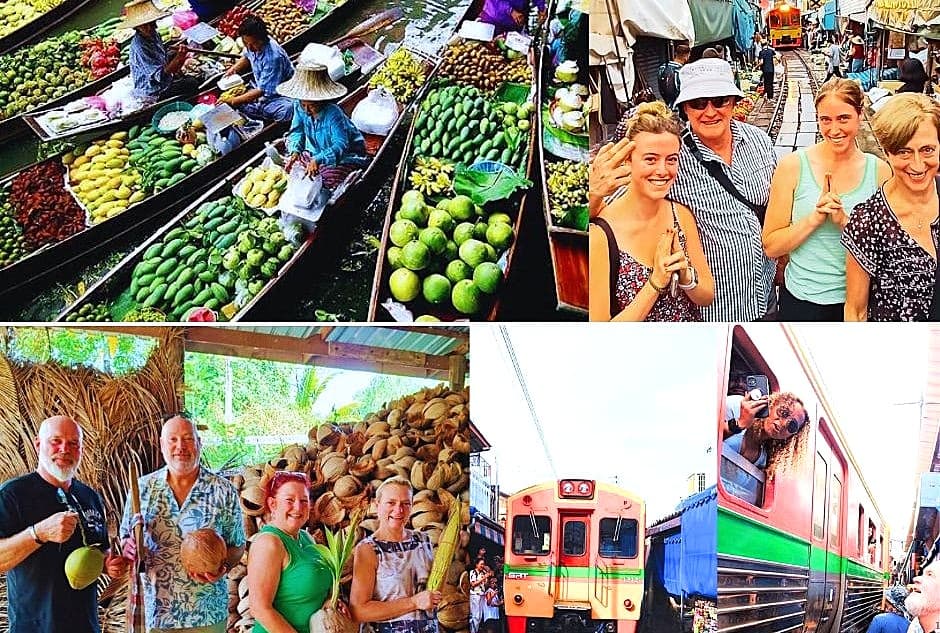
As your wooden longtail boat zips through the narrow canals, the silence shatters into a vivid explosion of colors and sounds. The riverbanks transform into a floating marketplace.
Here, elderly vendors wearing traditional woven Ngob hats navigate their tiny wooden canoes with impossible grace. The boats themselves are works of art, piled high with treasures from the earth: bright green mangoes, hairy red rambutans, and aromatic bundles of lemongrass.
The air is thick with the scent of Boat Noodles simmering in rich, spiced broths, and fresh seafood grilled right over charcoal inside the canoes. Money and bowls of hot food are exchanged between boats with a practiced sleight of hand.
It is a bustling, chaotic ballet on water, where the river isn't just a resource — it is the living room of the community.
Chapter 3: Facing the Iron Dragon
But the ultimate climax of this journey lies where water meets steel at the Maeklong Railway Market, known locally as Talad Rom Hup — The Closing-Umbrella Market.
At first glance, it looks like a vibrant, ordinary Thai market. Stalls are packed tightly together, spilling over with fresh mackerel, exotic spices, and colorful vegetables. But look down at your feet. You aren't walking on concrete. You are walking directly on active train tracks.
The vendors' baskets of produce are placed mere inches from the iron rails. The atmosphere is casual, until a sudden, piercing siren echoes through the air.
What happens next is pure magic.
Within seconds, without a single shred of panic, a synchronized symphony of survival begins. Vendors calmly pull back their canvas awnings. They slide their custom-wheeled vegetable crates back by just a few inches. The shoppers step into the narrow doorways of shops.
Then, the ground begins to shake.
A massive, multi-ton steel train rumbles directly through the center of the market, its wheels passing literally centimeters away from baskets of fresh fruit and the toes of onlookers. The train is so close you can feel the hot wind from its engine and lock eyes with the driver.
The moment the final train car passes, the market instantly inhales. Awnings snap back into place, crates slide back over the tracks, and business resumes as if the iron dragon was never there.
It is a jaw-dropping display of human adaptability — a place where life refuses to move for progress.
Chapter 4: The Unbroken Rhythm
The sugar farms, the river bazaars, and the railway market are not tourist shows staged for cameras. They are the beating heart of a resilient people who have learned to thrive along the rivers and the rails.
It is an extraordinary glimpse into a Thailand where tradition doesn't just survive — it commands the modern world to slow down and take notice.
Written & Photographed by Anthony T. Cool — Licensed Tour Guide & Cultural Storyteller
Join Anthony on a private full-day expedition to the Coconut Sugar Farms, Floating Markets, and Maeklong Railway Market. Contact Concierge to arrange your adventure.
Written & Photographed by
Anthony T. Cool
Licensed Tour Guide & Cultural Storyteller
8+ years guiding across Thailand, Vietnam, Laos & Cambodia · Ex-G Adventures Lead Guide · 1,000+ guests from 40+ countries
Explore Siam Aura
Sacred arts, curated with care.